


Driving America’s energy expansion from coast to coast
From the Carolinas to California, Siemens Energy supports customers nationwide in addressing energy challenges, from maintaining power to modernizing the grid.
The American road trip represents independence, adventure, and a sense of discovery made possible by the technological advancements of automobiles and massive upgrades to infrastructure, including the Interstate highway system.
For more than 140 years, Siemens Energy has been on its own journey to provide customers with world-class energy technologies that fast-track American energy abundance, spur growth, and foster independence.
Our tour starts in Pittsburgh
Siemens Energy’s U.S. journey began in the 1880s in Pittsburgh, Pennsylvania, with a mission to advance electrical infrastructure in the U.S. Through the years, the company’s legacy has grown alongside the nation’s industrial and technological evolution, with equipment that now helps generate 25% of all electricity produced in the U.S.
We now help generate and support every form of American energy and provide solutions for balancing and strengthening the grid. We are here and everywhere in the U.S., our technologies deployed in every state and territory.
Rich Voorberg
Former President of Siemens Energy North America
Today, Siemens Energy employs more than 12,000 people in more than 20 states, with major manufacturing, service, and innovation hubs embedded in local communities. These locations are engines of economic growth, job creation, and technological innovation.
The places we’ve been
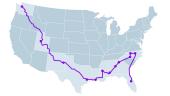
The company’s contributions to American energy have expanded significantly beyond that small factory in Pennsylvania more than a century ago. From coast to coast, here are some stops on Siemens Energy’s journey to help customers deliver more energy to more Americans.


Our future roadmap
The continued innovation of Siemens Energy remains key to American’s energy expansion. This includes pursuing education and workforce development, such as our $5 million partnership with the University of Central Florida, which supports sustainable energy research, talent development, and executive education—ensuring the next generation of engineers is ready to lead.
The company also supports veterans, apprenticeships, and STEM education programs, reinforcing its belief that a strong energy future depends on a strong, diverse, and skilled workforce.

Ensuring a more resilient and independent energy system requires getting in the driver seat. Throughout our journey, whether it’s upgrading aging infrastructure, integrating renewables, or deploying hydrogen-ready turbines, we bring a deep technical expertise and a collaborative spirit to every customer engagement. Mile by mile, we keep building on our more than a century legacy here to help deliver more energy to more Americans.
Rich Voorberg
Former President, Siemens Energy North America
- Seattle, WA
- Utah – Texas
- Houston, TX
- La. – Miss.
- Ala. – Ga.
- N.C.
- Orlando, FL
Innovation starts in Seattle
by Rich Voorberg
The United States is the largest economy in the world. For us to maintain that dominance, we need to produce and deliver more energy. 25 percent of total U.S. energy generation is powered by Siemens Energy technologies. From 25 facilities and 14 service centers throughout the United States, our more than 13,000 employees are a part of this country’s energy journey. To keep up with this unprecedented demand, Siemens Energy plans to add hundreds of jobs ensuring we are prepared for the future of energy, and of our nation.
From now until the close of the year, we are taking stock – looking at where we are now and offering a vision of where we are going. And what better way to do that than a road trip?
I have enlisted the help of thought leaders throughout the US for a drive coast to coast, taking in the sights and sounds and surveying the impact that Siemens Energy has made on our industry and our nation along the way.
My trip begins in the Pacific Northwest at Colman Dock in Seattle, WA. I am watching the Wenatchee come in from scenic Bainbridge Island. It is the first Washington State Ferry to undergo hybrid-electric conversion, becoming the largest U.S. ferry retrofitted with this technology. It is 460 feet long, can carry 2,499 passengers and 202 vehicles, and, when it launched in 1998, it was powered by four diesel engines. Washington State Ferries is in the middle of an effort to modernize the entire fleet and convert them to hybrid-electric power by 2040. They hired Siemens Energy to help.

When our work began, two of the four original diesel generators were removed by the shipyard and Siemens Energy added our BlueVault Energy Storage system, creating 5.7 MWh in total energy storage. Now, a Siemens Energy Power Management system directs power output when needed and stores energy when it isn’t. The Siemens Energy Charge Management System was installed in the Wenatchee and will be installed in all hybrid vessels as well as each electrified terminal. The Charge Management System will manage the connection between the vessel and the shore. When charging stations are installed at a later date, the Wenatchee is prepared to connect to them. With the advanced propulsion systems now installed, the Wenatchee will significantly reduce emissions, reduce fuel consumption, and reduce maintenance costs, setting a benchmark for future conversions. Once the shore plug-in system is installed, the Wenatchee and all future hybrid ferries will reduce carbon dioxide emissions by 76 percent.
From Seattle, I get on I-5 North and take 520 over Lake Washington to Redmond. This is the home of Microsoft and where Nintendo has their US headquarters. In 2024, Siemens Energy opened a new turbomachinery laboratory there focused on developing and testing technologies to support industrial decarbonization.
Here, we work with factories that make pulp and paper, which is a high-temperature process. Last year, the state of Washington gave us a grant to develop a transportable, electrically powered Turbo Heater. This novel technology generates high-temperature process heat without fuel combustion and has the ability to help decarbonize the pulp and paper industry, as well as other sectors that have traditionally had large emissions.
Cutting-edge innovation is what this area of the country is known for, so we fit right in. Our team in Redmond is also working on a rotating olefins cracker and an advanced rotor hydrogen compressor – more turbomachines that will reduce industrial emissions.
Olefins are a key building block in the chemical industry, particularly in the production of polymers, plastics, and other petrochemical products. They have historically been made using conventional furnaces. The rotating olefins cracker represents an efficient and sustainable breakthrough in the field of chemical processing. When driven by electric-powered motors or hydrogen-fired gas turbines, the technology creates a path to decarbonize production of light olefins. As industries continue to prioritize decarbonization and energy efficiency, innovations like the rotating olefins cracker will play a crucial role in shaping the future of chemical manufacturing.

Turbocompressors are used in multiple industrial processes. For challenging hydrogen compression applications, our high speed, multi-stage advanced rotor compressor can reduce the required equipment and footprint of these processes by more than 50 percent compared to conventional turbocompressor technology.
The team is also working on additional innovative decarbonization technologies for power generation and energy storage that utilize turbomachinery-based solutions.
Innovation dreams in the Seattle area become reality and change the world. Siemens Energy is doing our part – making technology that will transform the carbon footprint of manufacturing in America and throughout the world. And I couldn’t be happier to see it all with my own eyes.
I am handing the keys to Matt Neal, Siemens Energy’s Vice President of Grid Solutions for North America. He will take you on the next leg of the journey.
Creating inertia drives grid stability
by Matt Neal
As I make my way south and east from Seattle, grid stability is on my mind. So, I am making some stops in Utah, New Mexico and Texas - homes to our synchronous condenser projects. A synchronous condenser is essentially a generator that is used to absorb or provide steady-state flow to the electrical grid, deliver short circuit power and support inertia. Synchronous condensers are called upon frequently in the United States to fill needs of stable power grid transmission. Higher levels of intermittent power, such as wind and solar, are being added to our electrical grid and are replacing older rotating equipment like coal. Synchronous condensers can help stabilize a grid when there is deep penetration of these intermittent resources.
My stop in Utah is the Intermountain Power Project (IPP) in the city of Delta, near the mineral-rich Topaz Mountain.

The Intermountain Power Project (IPP) in Delta, UT.
IPP is undergoing a transformation from coal to natural gas, and to support this transformation, Siemens Energy delivered Generator Step up Transformers in June of 2024 and later added three synchronous condensers. This is the largest condenser project at one location in the United States and possibly the world. These condensers greatly increase the amount of energy from IPP that can be delivered to project participants in Southern California. In fact, the high-voltage direct current line from Delta to Adelanto, CA cannot run at 100 percent without these condensers.
In New Mexico, I stop in Clovis, known for its archaeological discoveries and early contributions to rock and roll. Siemens Energy installed a synchronous condenser here in 2018 that helps balance the 200 MW of wind capacity being delivered along a 216-mile transmission line to the Albuquerque area.
Wind generation facilities tend to be located far from demand centers, presenting utilities with control and operational challenges. This has lead to increased interest in synchronous condensers.

As I exit New Mexico, I enter West Texas, where Siemens Energy has been awarded engineering, procurement, and construction contracts to supply 10 synchronous condensers. The Electric Reliability Council of Texas (ERCOT) said in a report that the implementation of synchronous condensers would effectively bolster the reliability of the West Texas system, make the system more resilient to unexpected events, and address the challenges that may arise in real-time operations. I share ERCOT’s hope that the next time I roll through here, the grid will be more reliable for people on this side of the Lone Star State.
Before this road trip heads to Houston, I’m going to hand off the keys to Mariangel Melean, Vice President of Service Region North and Latin America for Compression.
Rolling through the Energy Capital of the World
by Mariangel Melean
Houston plays a dominant role in the global energy industry. The world’s biggest energy companies, including Siemens Energy, maintain a large presence here. The city has a vast network of pipelines, refineries, and petrochemical plants. The Port of Houston is one of the busiest in the nation, especially for energy exports. Texas is the largest producer in the United States of oil, natural gas and wind energy.
Siemens Energy has been in Texas for several decades and now has 1,600 employees in multiple locations throughout Houston. My first stop here is our facility on Telge Road, where we just completed construction on a new centrifugal compressor test stand.
Construction of the expanded Telge Road test facility began in November 2021, with the first customer performance test taking place in May 2023. The grid connection was upgraded with a new medium-voltage substation and switch gear, allowing the test facility to be powered independently from the rest of the 12,000 square foot campus which handles new equipment packaging and compressor assembly. We also have a service center on Lumpkin Road that spans 130,000 square feet where we enhance performance and extend the lifespan of our compressors.

Siemens Energy compressors are used for moving liquid and gas. They are used in oil and gas pipelines and at liquified natural gas export facilities. In the past few years, we have worked with customers on some innovative uses for this machinery. Siemens Energy compressors are being used at Occidental’s first large-scale Direct Air Capture plant in Texas’ Permian Basin. The two compressor packages will enable the plant to capture up to 500,000 metric tons of CO2 per year when fully operational.
From there, I make a short drive to Siemens Energy’s West Houston Campus where 918 employees representing 22 different nationalities support a variety of our products. The campus is two office buildings and three production buildings including our 40,000 square foot Training Competence Center. The Training Center offers certifications and training for Siemens Energy employees and customers - nearly 1,000 students annually - in various technologies such as laser scanning, augmented reality, virtual reality and additive manufacturing.
My last stop in Houston is our facility in Deer Park, which specializes in engineering and manufacturing services for turbines and generators. This facility serves as a hub for engineering services, repairs, and maintenance related to power generation equipment used worldwide. This site also includes Siemens Energy Field Service Products training facility, which includes full-size mockups of large gas turbines, generator rotors, stators, and steam turbine rotors. We do hands-on training as part of our Field Engineer in Training program there, designed to develop technical skills in gas turbine and generator maintenance and repair.
Time to hand the keys to one of my colleagues who is going to keep traveling east.

Witnessing energy transformation and expansion
by Wade Lauer
I am heading southeast to Louisiana, starting with a visit to Pecan Island, a small community only 10 miles from the Gulf. There you will find the Pecan Island Carbon Capture, Utilization and Storage Project. Known as CCUS, it captures carbon dioxide (CO2) from industrial processes, which is then repurposed for various industries or stored safely underground.
Pecan Island CCUS captures a high concentration CO2 stream from a steel plant in Convent, Louisiana. Siemens Energy supplied a compressor, coolers for the compressor and other auxiliary systems. The compressor takes the CO2 stream from near atmospheric pressure to 2,400 pounds per square inch (psi). For comparison, the air we breathe is 14.7 psi. At 2,400 psi, CO2 acts simultaneously as a gas and liquid. This stream will then be transported via pipeline to a sequestration reservoir in the state.
I make my way out of Louisiana and through Mississippi. My first stop here is the city of Purvis, in the shadow of the sprawling DeSoto National Forest. Purvis has fewer than 2,000 residents, but it is home to the innovative Morrow Repowering Project. Siemens Energy helped convert the existing R.D. Morrow, Sr Generating Station from coal power to natural gas by supplying a cutting-edge gas turbine. Together with an existing steam turbine, the plant can produce up to 550 megawatts of electricity and has resulted in a roughly 50 percent reduction in CO2 emissions. This project was so successful that it went on to win Power Magazine’s 2024 Reinvention award. That is just one way we’re innovating in the Magnolia state.

Mississippi's R.D. Morrow, Sr Generating Station
Next stop is Richland, MS where our grid technologies business has been growing at an incredible rate.
Richland, MS is just 11 minutes south of Jackson, the state’s capital. Here we find the plant responsible for manufacturing and distribution of voltage regulators, arresters and circuit breakers. The Richland facility has been here since 1973 and is home to 550 of our employees. Their community outreach and sustainability programs truly embody southern hospitality. We pride ourselves on being active members of the community. We participate in Project SEARCH, a workplace immersion program for students with disabilities. We have donated time, gifts and resources to Batson Children’s Hospital, Sunnybrook Children’s Home and dozens of local organizations through clothing drives, blood drives, school supply drives, food drives and more. And we offer tours of our facilities to local school, exposing young minds to opportunities in manufacturing and the energy field.
Our local sustainability initiatives include recycling, composting, water conservation and planting 2,500 trees annually. In 2021, the Richland facility took home a U.S. Environmental Protection Agency Award after implementing systems resulting in more than 260,000 kilowatt hours of annual electricity savings and avoiding 239,000 pounds of annual CO2 equivalent emissions.
This Richland plant produces voltage regulators and circuit breakers including products from the innovative BLUE portfolio. We distribute surge arrestors and insulators from our neighboring Clinton location.
Siemens Energy has always been an industry leader; however, in 2021 we saw unprecedented growth in demand. Our products and solutions were what the industry needed and wanted. We had to tackle the humbling and exciting challenge of meeting customer demand in a timely fashion.

An expansion plan was born and by 2026, our throughput in Richland will increase by 100 percent. Our plant manufacturing space has increased by 55,000 square feet and we have secured other locations for storage and distribution. We have also added numerous benefits for our growing employee base like a walking trail, in-house training and an upgraded cafeteria.
No matter what region of America you’re in, Siemens Energy is innovating and engaging with the community. The technology we make in Mississippi is paving the way for the future of energy.
The future of this road trip has us heading east, but that leg belongs to someone else. So, I am handing off the keys.
Energy solutions in all shapes and sizes
by Andy Goggin
My leg of this journey will end in Charlotte, North Carolina, but I have a few stops to make before I get there. We have estimated that there are 46,000 units of Siemens Energy equipment deployed in the United States today. They come in all shapes and sizes and serve numerous different functions. I can’t see them all, but, as I make my way east, I plan to hit a few spots that highlight the incredible breadth of the Siemens Energy portfolio and the many contributions we make to energizing our nation.
In Alabama, I swing by McIntosh, a small town near the city of Mobile. This is the home of the McIntosh Power Plant, a Compressed Air Energy Storage (CAES) Plant. CAES technology is used in only a handful of applications worldwide.
Built above a cavern located 1,500 feet underground that provides 19.8 million cubic feet of storage, the plant uses off-peak electricity to pump air into the cavern. During the peak periods, the plant uses this air combined with natural gas to generate and supply power. Siemens Energy supplied the technology to this plant when it was built in 1991. We are now repairing and upgrading the plant, ensuring it operates efficiently for years to come.

I take I-65 N to Alexander City, AL, next to Lake Martin which is a popular getaway spot for folks in the area. I’m here to visit the Hillabee Generating Station, just a quick drive from the city proper.
Here, 38.8 percent hydrogen was blended with natural gas and successfully fed into a Siemens Energy gas turbine, setting an industry record. It was a demonstration back in May 2023, but if this blend was used fulltime, it would reduce the plant’s carbon emissions by 270,000 metric tons annually, which is equivalent to taking about 60,000 cars off the road. Siemens Energy has set a goal for all of our gas turbines to be capable of running on 100 percent hydrogen by 2030.

The Hillabee Generating Station in Alabama.
I make my way out of Alexander City to my last stop in Alabama, the city of Fort Payne. In 1907, people started making socks in Ft. Payne and it grew into a cottage industry in the 50s. By the late 1990s, more than 130 sock mills operated in Fort Payne. Well-known companies like Gold Toe and Wigwam Mills had facilities there and Fort Payne became the largest single location of sock manufacturing in America. In 1988, Siemens Energy opened a facility Fort Payne which is now the leading source of new copper and insultation electrical components for industrial and larger electrical generators. There, we make parts like stator bars and rotor coils. These components work together inside electric motors and generators to convert electrical energy into mechanical motion.
From Fort Payne, I get on the GA-20 E to Georgia, the Peach State. My stop here is the city of Alpharetta, just outside Atlanta. Alpharetta is a vast tech hub with approximately 900 tech businesses, including Siemens Energy.
At our Alpharetta facility, we have a dedicated team of about 180 employees. This site serves as an assembly center for control panels, supports our digitalization efforts and houses a cybersecurity call center. Alpharetta is the North American hub for custom design controls. It is also the center of competency for the Omnivise T3000, Siemens Energy’s advanced Distributed Control System which helps manage complex energy systems from conventional power plants to renewable energy installations.

Our facility in Alpharetta, GA supports digitalization efforts and houses a cybersecurity call center.
Omnivise currently supports upwards of 300 energy systems in North and South America and Alpharetta offers a 24/7 hotline for our customers using this technology.
In just one sweep through a small part of this great country, I saw Siemens Energy equipment that weighs 300 metric tons, parts that I can hold in my hand and virtual products that help keep energy flowing to 350 million Americans. Now it is time for me to head to Charlotte and hand off the keys.
Deep roots, bright future
by Tonya Klingen
Siemens Energy and North Carolina go all the way back to 1969. We have enjoyed a long and prosperous relationship with the Tarheel State and that connection continues to yield incredible results. I am going to take a spin around the state to a few of our sites and tell you about the incredible work being done there.
I’ll start in Charlotte where 1,300 Siemens Energy employees work on a portfolio that includes generators, steam turbines, gas turbines and combustion components. Charlotte is our global lead for generator manufacturing. Generators convert mechanical energy from a turbine into electrical energy using electromagnetic induction. They are efficient, reliable, and capable of operating under a wide range of conditions, making them essential in various energy production methods, including fossil fuel plants, nuclear power stations, and renewable energy facilities.

Charlotte gas turbine site
In 2024, we announced that we will expand the Charlotte campus to build a factory that makes large power transformers. Large power transformers are around the size of a standard school bus, and they are essential components in any grid expansion. They enable the reliable transmission of electricity over long distances and help stabilize electrical transmission across regions. To continue to remain flexible as the energy industry grows and changes, Siemens Energy’s transformer manufacturing facility and service center will be a new building rather than repurposing existing factory space. This decision helps maintain the factory’s current capabilities and enables continued expansion if needed.
Once the transformer manufacturing facility and service center is completed, Siemens Energy will be able to hire 475 new employees at this site – an effort supported by the State of North Carolina along with the North Carolina Community College System, the North Carolina Railroad Company, Mecklenburg County and the city of Charlotte. Our relationship with University of North Carolina at Charlotte and Central Piedmont Community College has been indispensable for building and maintaining a qualified workforce in the area.
Leaving Charlotte, I take Interstate 85 north to Rural Hall, NC which is about 20 minutes outside of Winston Salem. Named for a community center built in 1832 that occupies a prominent place in the city, this spirit inspires the work of Siemens Energy in the area and our commitment to the community. At our Winston Technology Center in Rural Hall, we manufacture parts for power generation systems used around the world and service existing equipment. It is a hub of innovation, precision manufacturing and community-focused workforce development. 400 machinists, welders, programmers and engineers work there. Some employees lived there previously, others have moved to the area to take these jobs, and there are a growing number that come through the apprenticeship and industry leadership programs at Forsyth Technical Community College.
And that innovation that I mentioned? It’s here. On November 11, Siemens Energy marked an exciting new chapter in the history of the Rural Hall facility, opening our US center for Additive Manufacturing. We created a dedicated space within our existing facility where we have consolidated our development and production operations. Our significant history and experience with additive manufacturing technologies and applications aligns perfectly with already existing production and repair capabilities at this site. It will enhance Siemens Energy’s ability to support our customers.
From Rural Hall, it is a nearly two-hour drive on I-40 to Raleigh, NC.

We just moved into a new space in Raleigh because our grid technologies business, which uses that location, is expanding rapidly. The new space is more than 55,000 square feet, which includes offices and 17,000 square feet of lab space for testing high-voltage direct current (HVDC) control systems. When transporting electricity over long distances, upgrading to high voltage is advantageous because it reduces lost electricity along the journey. We are working on installing these systems for large transmission projects that plan to deliver energy across multiple states. HVDC can also be useful for offshore wind projects that are more than a certain distance from the shore.

Raleigh skyline
Siemens Energy is driven to give to North Carolina because the state has given so much to us. Our relationship goes back a long time, but, as you can see, there is so much more that we have to accomplish together. Stay tuned.
No tour of Siemens Energy in the United States would be complete without a tour of Orlando, Florida. I am going to hand off the keys so you can see all the incredible things that we do in Central Florida.
Ending on a high note
by Matt Neal
As the new President for Siemens Energy in North America, I am delighted to be behind the wheel again to bring this road trip to its conclusion. Working for Siemens Energy for 18 years, I have traveled to sunny Orlando, Florida countless times.
Once known primarily for its citrus groves, that changed when the Walt Disney World Resort opened in 1971. Now, Orlando is one of the most visited cities in the United States. Orlando is home to other theme parks in addition to the Disney properties and tourist attractions such as Universal Studios Florida and the bustling International Drive.
Lockheed Martin, Electronic Arts and the American Automobile Association’s (AAA) have a significant presence in the city and it’s where Siemens Energy has its largest footprint in North America – and that’s my first stop on this trip.

Siemens Energy Orlando Quad 1 Campus
We’ve been at this location on North Alafaya Trail for more than 40 years. In 1983, Westinghouse Electric relocated its employees from Pennsylvania to Orlando, constructing a headquarters across from the University of Central Florida (UCF). Siemens Energy, who acquired Westinghouse Electric in 1998, now operates the main campus made up of two buildings and more than 3,000 employees, as well as other local facilities that include Casselberry Labs and the state-of-the-art FAST Logistics Center. These dedicated folks perform a wide assortment of duties such as engineering, sales, IT, cybersecurity, finance, accounting, communications and much more.
Siemens Energy’s entire US operation can be viewed through the lens of our Orlando presence. It is where much of our 360-degree approach to coordination, consultation and training takes place. We have a plan to hire up to 1,000 additional field engineers, quality engineers, project managers and safety leads. All of these new hires will receive their training in Orlando and some of them will be based in Orlando. But others will be deployed throughout the United States. When he was driving through Alabama and Georgia, Andy Goggin told us that there are an estimated 46,000 units of Siemens Energy equipment deployed in the United States today. We deploy our service employees all around the country, so they can be closer to this equipment and available when needed. Siemens Energy conducted more than 50,000 different trainings in the past two years. We even offer operations and maintenance training for customers who want to train their employees to reach highest value of reliability and availability of their power plants.
Our neighbors at UCF are an incredible resource. We have invested more than $13 million in research at the university since 1996 and we employ more than 900 UCF alumni. Last year, we committed to investing an additional $5 million in their research, talent development, and executive education initiatives and were named a “Pegasus Partner”, the university’s highest partnership.
I step out of my office and take the short drive on North Alafaya Trail to the Innovation Center Orlando.
The first and largest Siemens Energy global hub for innovation, the center is a sleek facility dedicated to accelerating the development of products and solutions to drive the energy transition through collaboration, rapid prototyping, and testing. Two exciting projects we are working on at the Innovation Center are a Direct Air Carbon Capture (DAC) solution and the Inductive E-Heater.
Our Direct Air Carbon Capture solution pulls carbon dioxide directly from the atmosphere for reuse or permanent underground sequestration. The successful completion of a DAC demonstrator unit has positioned Siemens Energy among a select group of global companies capturing CO2, with further plans to scale up the technology through partnerships and feasibility studies.

The Inductive E-Heater is designed to make industrial heating cleaner and more efficient by using large electric heaters powered by induction and including special systems to store heat for later use. The team has proven that this technology works and is now working with partners to test a bigger version—a 7.5-megawatt pilot project. The goal is to eventually use this technology to turn old coal power plants into facilities that can store energy for long periods.
Before I head out of the Innovation Campus, I take a quick break to look at some fun stuff on display—technologies that our teams have developed in their ongoing pursuit of excellence and entertainment. We have an electric motorcycle, intricate models of some of our energy technology products, and “battle bots” leftover from a summer competition.
Next, I take State Road 417 to our state-of-the-art Wind Training Center (pictured, right), located near Orlando International Airport.
Our Wind Training Center is also home to the Wind Academy, which is the only wind turbine manufacturer-based school in the United States and offers Global Wind Organization certificates to students in only three weeks. We train over 500 technicians here each year, equipping them with the skills they need to install and repair wind energy equipment. The 40,000 square-foot facility includes nine classrooms, three simulation labs, three climbing towers, two advanced rescue simulators, and two full-sized nacelles.
I exit the Wind Academy and take a short drive to our exciting future: the community of Lake Nona. Spanning 17 square miles within Orlando, Lake Nona is a planned community featuring a vibrant town center, the innovative Lake Nona Medical City, and ample business space. KPMG has their national training center here and the Dubai National Air Travel Agency (dnata) headquarters is here. In 2027, we will join this landscape by moving our offices to the community’s Class A office at 6876 Marwick Lane. Designed with energy efficiency in mind, the 242,000 square foot office is in the heart of the community, surrounded by restaurants, fitness and wellness facilities, apartments, and hotels.
As we wrap up our trip, I also find myself reflecting on the miles we have covered and the road ahead. My predecessor, Rich Voorberg, started this road trip with the goal of evaluating where we were and where we were heading. We explored 10 states, heard from six of our thought leaders, and visited several of our facilities and projects. As I stand in front of our new home in Lake Nona, I can’t help but be proud about our impact on the United States. But there is nothing more American than looking toward the future—and that is where I have set my sights. On to the next journey!

Energy Stories

Reinventing the grid for the era of renewables

EU F-Gas Regulation: Beyond the SF₆ switchgear phase-out

Siemens Energy to supply HL turbine to Associated Electric Cooperative for new peaking plant in Oklahoma, USA

Siemens Energy gas turbines support rising electricity demand in Iowa

References

Start Campus, Portugal: Renewable energy for hyperscale data center

Naturgy, Spain: Upgrading gas turbines and used software optimization to reduce fuel consumption by up to 50%

SuedLink HVDC, Germany: Connecting clean power
