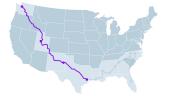
From the Carolinas to California, Siemens Energy supports customers nationwide in addressing energy challenges, from maintaining power to modernizing the grid.
The American road trip represents independence, adventure, and a sense of discovery made possible by the technological advancements of automobiles and massive upgrades to infrastructure, including the Interstate highway system.
For more than 140 years, Siemens Energy has been on its own journey to provide customers with world-class energy technologies that fast-track American energy abundance, spur growth, and foster independence.
Siemens Energy’s U.S. journey began in the 1880s in Pittsburgh, Pennsylvania, with a mission to advance electrical infrastructure in the U.S. Through the years, the company’s legacy has grown alongside the nation’s industrial and technological evolution, with equipment that now helps generate 25% of all electricity produced in the U.S.
We now help generate and support every form of American energy and provide solutions for balancing and strengthening the grid,. We are here and everywhere in the U.S., our technologies deployed in every state and territory.
President of Siemens Energy North America
Today, Siemens Energy employs more than 12,000 people in more than 20 states, with major manufacturing, service, and innovation hubs embedded in local communities. These locations are engines of economic growth, job creation, and technological innovation.
The company’s contributions to American energy have expanded significantly beyond that small factory in Pennsylvania more than a century ago. From coast to coast, here are some stops on Siemens Energy’s journey to help customers deliver more energy to more Americans.
The continued innovation of Siemens Energy remains key to American’s energy expansion. This includes pursuing education and workforce development, such as our $5 million partnership with the University of Central Florida, which supports sustainable energy research, talent development, and executive education—ensuring the next generation of engineers is ready to lead.
The company also supports veterans, apprenticeships, and STEM education programs, reinforcing its belief that a strong energy future depends on a strong, diverse, and skilled workforce.
Ensuring a more resilient and independent energy system requires getting in the driver seat. Throughout our journey, whether it’s upgrading aging infrastructure, integrating renewables, or deploying hydrogen-ready turbines, we bring a deep technical expertise and a collaborative spirit to every customer engagement. Mile by mile, we keep building on our more than a century legacy here to help deliver more energy to more Americans.
President, Siemens Energy North America
by Rich Voorberg
The United States is the largest economy in the world. For us to maintain that dominance, we need to produce and deliver more energy. 25 percent of total U.S. energy generation is powered by Siemens Energy technologies. From 25 facilities and 14 service centers throughout the United States, our more than 13,000 employees are a part of this country’s energy journey. To keep up with this unprecedented demand, Siemens Energy plans to add hundreds of jobs ensuring we are prepared for the future of energy, and of our nation.
From now until the close of the year, we are taking stock – looking at where we are now and offering a vision of where we are going. And what better way to do that than a road trip?
I have enlisted the help of thought leaders throughout the US for a drive coast to coast, taking in the sights and sounds and surveying the impact that Siemens Energy has made on our industry and our nation along the way.
My trip begins in the Pacific Northwest at Colman Dock in Seattle, WA. I am watching the Wenatchee come in from scenic Bainbridge Island. It is the first Washington State Ferry to undergo hybrid-electric conversion, becoming the largest U.S. ferry retrofitted with this technology. It is 460 feet long, can carry 2,499 passengers and 202 vehicles, and, when it launched in 1998, it was powered by four diesel engines. Washington State Ferries is in the middle of an effort to modernize the entire fleet and convert them to hybrid-electric power by 2040. They hired Siemens Energy to help.
When our work began, two of the four original diesel generators were removed by the shipyard and Siemens Energy added our BlueVault Energy Storage system, creating 5.7 MWh in total energy storage. Now, a Siemens Energy Power Management system directs power output when needed and stores energy when it isn’t. The Siemens Energy Charge Management System was installed in the Wenatchee and will be installed in all hybrid vessels as well as each electrified terminal. The Charge Management System will manage the connection between the vessel and the shore. When charging stations are installed at a later date, the Wenatchee is prepared to connect to them. With the advanced propulsion systems now installed, the Wenatchee will significantly reduce emissions, reduce fuel consumption, and reduce maintenance costs, setting a benchmark for future conversions. Once the shore plug-in system is installed, the Wenatchee and all future hybrid ferries will reduce carbon dioxide emissions by 76 percent.
From Seattle, I get on I-5 North and take 520 over Lake Washington to Redmond. This is the home of Microsoft and where Nintendo has their US headquarters. In 2024, Siemens Energy opened a new turbomachinery laboratory there focused on developing and testing technologies to support industrial decarbonization.
Here, we work with factories that make pulp and paper, which is a high-temperature process. Last year, the state of Washington gave us a grant to develop a transportable, electrically powered Turbo Heater. This novel technology generates high-temperature process heat without fuel combustion and has the ability to help decarbonize the pulp and paper industry, as well as other sectors that have traditionally had large emissions.
Cutting-edge innovation is what this area of the country is known for, so we fit right in. Our team in Redmond is also working on a rotating olefins cracker and an advanced rotor hydrogen compressor – more turbomachines that will reduce industrial emissions.
Olefins are a key building block in the chemical industry, particularly in the production of polymers, plastics, and other petrochemical products. They have historically been made using conventional furnaces. The rotating olefins cracker represents an efficient and sustainable breakthrough in the field of chemical processing. When driven by electric-powered motors or hydrogen-fired gas turbines, the technology creates a path to decarbonize production of light olefins. As industries continue to prioritize decarbonization and energy efficiency, innovations like the rotating olefins cracker will play a crucial role in shaping the future of chemical manufacturing.
Turbocompressors are used in multiple industrial processes. For challenging hydrogen compression applications, our high speed, multi-stage advanced rotor compressor can reduce the required equipment and footprint of these processes by more than 50 percent compared to conventional turbocompressor technology.
The team is also working on additional innovative decarbonization technologies for power generation and energy storage that utilize turbomachinery-based solutions.
Innovation dreams in the Seattle area become reality and change the world. Siemens Energy is doing our part – making technology that will transform the carbon footprint of manufacturing in America and throughout the world. And I couldn’t be happier to see it all with my own eyes.
I am handing the keys to Matt Neal, Siemens Energy’s Vice President of Grid Solutions for North America. He will take you on the next leg of the journey.
by Matt Neal
As I make my way south and east from Seattle, grid stability is on my mind. So, I am making some stops in Utah, New Mexico and Texas - homes to our synchronous condenser projects. A synchronous condenser is essentially a generator that is used to absorb or provide steady-state flow to the electrical grid, deliver short circuit power and support inertia. Synchronous condensers are called upon frequently in the United States to fill needs of stable power grid transmission. Higher levels of intermittent power, such as wind and solar, are being added to our electrical grid and are replacing older rotating equipment like coal. Synchronous condensers can help stabilize a grid when there is deep penetration of these intermittent resources.
My stop in Utah is the Intermountain Power Project (IPP) in the city of Delta, near the mineral-rich Topaz Mountain.
The Intermountain Power Project (IPP) in Delta, UT.
IPP is undergoing a transformation from coal to natural gas, and to support this transformation, Siemens Energy delivered Generator Step up Transformers in June of 2024 and later added three synchronous condensers. This is the largest condenser project at one location in the United States and possibly the world. These condensers greatly increase the amount of energy from IPP that can be delivered to project participants in Southern California. In fact, the high-voltage direct current line from Delta to Adelanto, CA cannot run at 100 percent without these condensers.
In New Mexico, I stop in Clovis, known for its archaeological discoveries and early contributions to rock and roll. Siemens Energy installed a synchronous condenser here in 2018 that helps balance the 200 MW of wind capacity being delivered along a 216-mile transmission line to the Albuquerque area.
Wind generation facilities tend to be located far from demand centers, presenting utilities with control and operational challenges. This has lead to increased interest in synchronous condensers.
As I exit New Mexico, I enter West Texas, where Siemens Energy has been awarded engineering, procurement, and construction contracts to supply 10 synchronous condensers. The Electric Reliability Council of Texas (ERCOT) said in a report that the implementation of synchronous condensers would effectively bolster the reliability of the West Texas system, make the system more resilient to unexpected events, and address the challenges that may arise in real-time operations. I share ERCOT’s hope that the next time I roll through here, the grid will be more reliable for people on this side of the Lone Star State.
Before this road trip heads to Houston, I’m going to hand off the keys to Mariangel Melean, Vice President of Service Region North and Latin America for Compression.
by Mariangel Melean
Houston plays a dominant role in the global energy industry. The world’s biggest energy companies, including Siemens Energy, maintain a large presence here. The city has a vast network of pipelines, refineries, and petrochemical plants. The Port of Houston is one of the busiest in the nation, especially for energy exports. Texas is the largest producer in the United States of oil, natural gas and wind energy.
Siemens Energy has been in Texas for several decades and now has 1,600 employees in multiple locations throughout Houston. My first stop here is our facility on Telge Road, where we just completed construction on a new centrifugal compressor test stand.
Construction of the expanded Telge Road test facility began in November 2021, with the first customer performance test taking place in May 2023. The grid connection was upgraded with a new medium-voltage substation and switch gear, allowing the test facility to be powered independently from the rest of the 12,000 square foot campus which handles new equipment packaging and compressor assembly. We also have a service center on Lumpkin Road that spans 130,000 square feet where we enhance performance and extend the lifespan of our compressors.
Siemens Energy compressors are used for moving liquid and gas. They are used in oil and gas pipelines and at liquified natural gas export facilities. In the past few years, we have worked with customers on some innovative uses for this machinery. Siemens Energy compressors are being used at Occidental’s first large-scale Direct Air Capture plant in Texas’ Permian Basin. The two compressor packages will enable the plant to capture up to 500,000 metric tons of CO2 per year when fully operational.
From there, I make a short drive to Siemens Energy’s West Houston Campus where 918 employees representing 22 different nationalities support a variety of our products. The campus is two office buildings and three production buildings including our 40,000 square foot Training Competence Center. The Training Center offers certifications and training for Siemens Energy employees and customers - nearly 1,000 students annually - in various technologies such as laser scanning, augmented reality, virtual reality and additive manufacturing.
My last stop in Houston is our facility in Deer Park, which specializes in engineering and manufacturing services for turbines and generators. This facility serves as a hub for engineering services, repairs, and maintenance related to power generation equipment used worldwide. This site also includes Siemens Energy Field Service Products training facility, which includes full-size mockups of large gas turbines, generator rotors, stators, and steam turbine rotors. We do hands-on training as part of our Field Engineer in Training program there, designed to develop technical skills in gas turbine and generator maintenance and repair.
Time to hand the keys to one of my colleagues who is going to keep traveling east.
Matt Neal is the President of Siemens Energy North America.
Siemens Energy is investing $1 billion and creating highly skilled jobs in the United States
Today marks an important milestone for Siemens Energy and for the future of energy manufacturing in America.
We’re investing $1 billion to expand our production capabilities and strengthen our capacity to support the nation’s growing energy needs.
With more than a century here in the U.S., we’re proud to continue investing in our workforce and technology.
It’s been a fast‑paced, collaborative start to the year!
Our main focus in 2026 is accelerating speed to power – how can we help our customers bring more power (and bring it faster) - to more people in the U.S. and Canada.
As part of my continued road trip, I kicked off the year with a behind-the-scenes look at our new construction project in Charlotte, where we’ve started building what will become our new large power transformer factory to help address the national transformer shortage and reduce multi-year lead times for grid-connected loads.
I spent some time at our three facilities in Houston last week
Houston is a city where I spent the first decade of my career. In many ways, it’s still the same place I remember: a place with a true entrepreneurial spirit and a real commitment to “getting stuff done.”
It’s also a city of expansion: population-wise, metro Houston is now ~7.8M people, - among the fastest-growing major U.S. cities. All that growth also means a critical need for more energy, in all forms. At Siemens Energy, we’re ready to help customers meet that momentum, with reliable technologies for oil and gas, for generation, for stronger grids, and for renewables too.
From Berlin to North America!
Our “road trip” took us to Germany, where we honored the incredible talent behind our Passion for Energy Awards—a celebration of innovation and collaboration.
North America was awarded with the Innovation of the Year Award! This recognition celebrates groundbreaking ideas that deliver real business impact for Siemens Energy and our customers. Our SMART Pricing Methodology, powered by data and AI, is optimizing costs and driving additional profit—positioning us as an industry leader.
Stepping into my new role
Over the past few weeks, I’ve had the privilege of visiting with customers, employees, and policymakers across the U.S. as I step into my new role as President of North America for Siemens Energy. It’s been a great introduction to see how we’re driving energy expansion every day, from education to grid to digitalization.
Some highlights from my travels so far...
Tim Holt is a member of the Executive Board and Labor Director at Siemens Energy.
Envisioning the future grid
Today’s energy systems face massive challenges. Growing electricity demand, soaring renewables, extreme weather events, aging infrastructure, and rapid digitalization – all of which add complexity, especially to the grid infrastructure.
That’s why, at Siemens Energy, we envision the future grid as digital, interconnected, and above all intelligent. Capable of turning insights into action.
Our vision for such a grid now has a name: “Noedra – the Mind of the Grid”. Our new, unified digital grid portfolio is designed to structure, guide, sense and protect the grid better than ever before. It will allow us to not only digitize products, but whole energy systems. This way, we can move from reactive operations to optimized, predictive, and autonomous grid performance.
A massive investment of $1 billion in the U.S.
Big News from Siemens Energy! We’re making a massive investment of $1 billion to scale up our U.S. manufacturing footprint. This way, we’re setting the stage for further growth, local job creation, and a resilient energy infrastructure across the country.⚡
A huge portion of this investment goes into our grid technologies’ production.
Mind of the Grid
Something new is awakening within the grid. Something like a mind. A mind that analyzes tons of data, anticipates critical developments, and advises respective actions. What exactly does this mean?
Stay tuned when we reveal details at this year’s DISTRIBUTECH 2026, San Diego.
Thank you suppliers!
Our sincere gratitude to all our suppliers for helping us build a reliable, affordable and sustainable energy system. It's great to have you on our side, and it was a pleasure to experience such a positive atmosphere at our GT Supplier Collaboration Day.
The evolving landscape of data center investment
In a world where our hunger for energy is growing faster than ever, AI is turbocharging this appetite! Data centers are emerging at an astonishing speed – and we need a lot of energy and investment to power this boom.
That’s why I was pleased to discuss the evolving landscape of data center investment during a panel at the Datacloud Global Congress 2025. In fact, top priorities for data center providers remain energy security, market scale, robust supply chains, and the role of skilled workers.